
You’ve just been told you need IV therapy. After the initial shock, your mind immediately goes to: “Will my insurance cover this?” You’re not alone, this is the first question nearly every patient asks. Navigating the world of insurance for IV therapy can feel like a maze of complex terminology, confusing policies, and the ever-present fear of surprise bills. The good news is that understanding what insurance covers, why, and how the approval process works puts you in control of your healthcare journey.
At AmeriPharma Infusion Center, we believe that dealing with insurance paperwork shouldn’t add to your stress when you’re already managing a health condition. Our dedicated team of insurance specialists has a proven track record, having secured over $55 million in financial assistance for our patients. We handle the complexities of insurance verification and prior authorizations so you can focus on what truly matters: your health and recovery.
This guide will break down the critical factors that determine insurance coverage for IV therapy, demystify the approval process, and explain how AmeriPharma’s expert team can lift the insurance burden from your shoulders. We’ll answer the crucial question, “Will insurance cover IV therapy for my specific situation?” and provide you with the knowledge to move forward with confidence.
The #1 Factor That Determines Coverage: Medical Necessity
The most important factor that determines whether your IV therapy will be covered by insurance is medical necessity. In simple terms, insurance companies will cover treatments that are prescribed by a physician to manage, treat, or cure a diagnosed medical condition. If your doctor determines that IV therapy is essential for your health, provides a formal diagnosis with the correct ICD-10 code, and your medical records support this decision, there is a strong likelihood that your insurance will cover the treatment.
On the other hand, IV therapy for general wellness or lifestyle purposes is almost never covered. These treatments, often marketed as “hangover cures,” “beauty drips,” or “athletic performance boosters,” are considered elective and not medically necessary. Patients seeking these types of infusions should expect to pay out-of-pocket.
To help clarify the distinction, we’ve created a table that outlines the types of IV therapies that are typically covered versus those that are not.
| Medically Necessary IV Therapy (Usually Covered) | Elective or “Wellness” IV Therapy (Almost Never Covered) |
|---|---|
| IVIG Therapy for conditions like Primary Immunodeficiency, CIDP, and Myasthenia Gravis. | Hangover relief or recovery drips, fertility*. |
| Biologic Infusions for autoimmune diseases such as Crohn’s disease, Rheumatoid Arthritis, and Multiple Sclerosis. | Athletic performance or energy boost infusions. |
| Specialty Medications like enzyme replacement therapy and chemotherapy drugs. | Anti-aging or beauty vitamin cocktails. |
| IV Antibiotics for serious infections such as endocarditis and osteomyelitis. | General wellness hydration without a medical diagnosis. |
| Other Medically Necessary Infusions including iron infusions for anemia and hydration for hyperemesis gravidarum. | IV vitamin therapy for general immune support. |
*IVIG for fertility is considered experimental or investigational and is not covered by insurance.
How place of service affects coverage:
IV infusion therapy coverage varies significantly by place of service (POS), such as a hospital, physician’s office, or the patient’s home. Payers, including Medicare and private insurers, have distinct policies for each setting, which can impact a patient’s out-of-pocket costs. For instance, in a hospital setting, the infusion is often billed as part of a bundled service, which may require more extensive clinical justification. Conversely, home infusion is frequently encouraged by payers to reduce costs.
For Medicare beneficiaries, the differences are particularly important to understand. When a patient receives an infusion in a hospital, the services are typically billed under Medicare Part A (for inpatients) or Part B (for outpatients), which covers the drug, supplies, and professional services as a package. However, for home infusions, Medicare coverage is structured differently. While Medicare Part B may cover the infusion pump and some professional services, the medication itself is often billed under Medicare Part D, the prescription drug benefit. This separation can lead to different cost-sharing responsibilities for the patient and is a common point of confusion. We often educate our patients on these nuances to ensure they understand why their coverage may differ between a hospital and a home setting.
Key Takeaway: If your doctor prescribes IV therapy with a specific diagnosis code to treat a documented medical condition, insurance will likely cover it. If you’re seeking IV therapy for general wellness without a medical diagnosis, you’ll pay out-of-pocket.
At AmeriPharma, we frequently see patients with the following conditions receive insurance approval for their IV therapy:
- Chronic Inflammatory Demyelinating Polyneuritis (IVIG)
- Multiple Sclerosis (Biologic)
- Common Variable Immunodeficiency (IVIG)
- Nonfamilial Hypogammaglobulinemia (IVIG)
- Myasthenia Gravis (IVIG)
- Rheumatoid Arthritis (Biologic)
- Iron Deficiency Anemia (Other IV)
Understanding How Insurance Approval for IV Therapy Works
The insurance approval process can seem opaque and intimidating from the outside. However, it follows a structured path that, when navigated by an experienced team, can be managed efficiently. Here is a step-by-step breakdown of what happens behind the scenes.
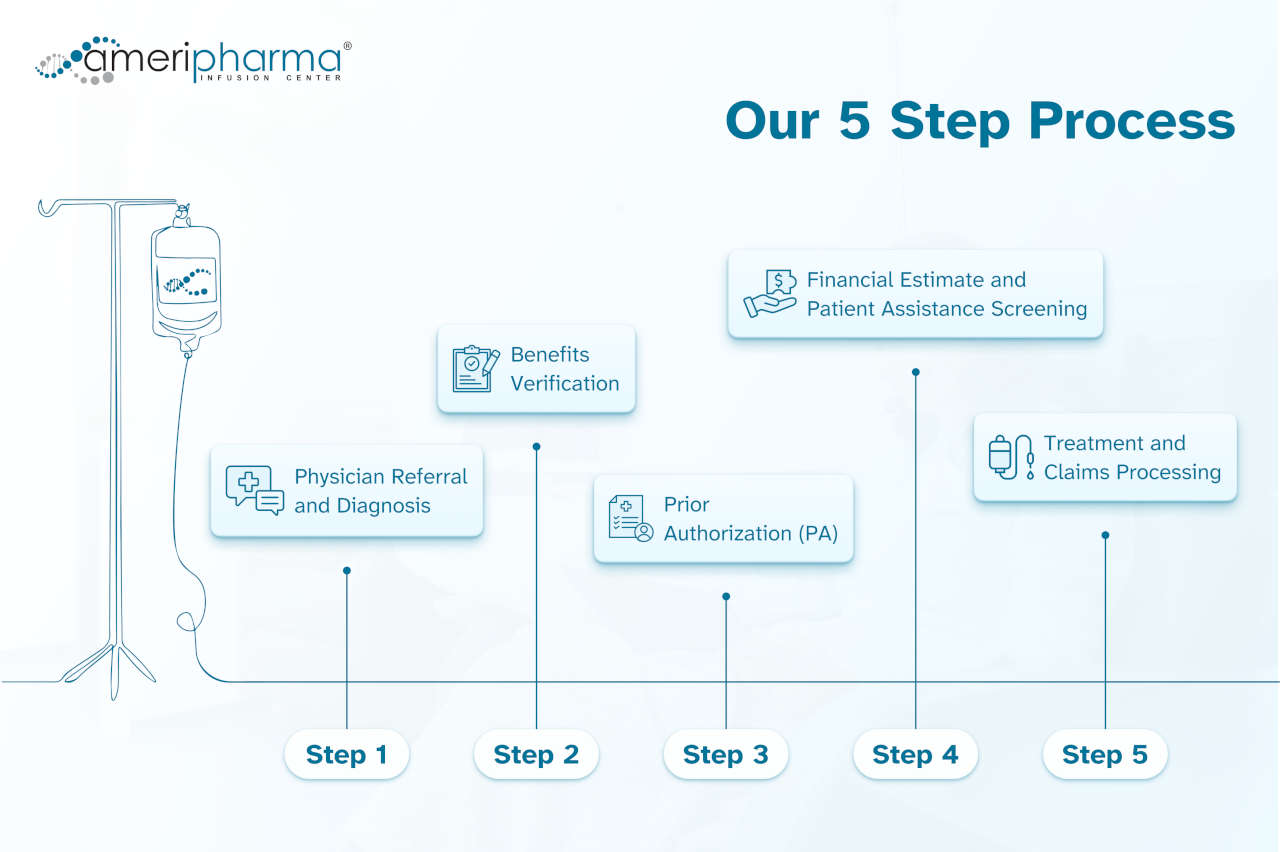
Step 1: Physician Referral and Diagnosis
The journey begins with your doctor. After diagnosing your condition, your physician will prescribe a specific IV therapy and provide the necessary medical documentation, including the crucial ICD-10 diagnosis codes. This documentation serves as the foundation for proving medical necessity to your insurance company.
Step 2: Benefits Verification
Before your first treatment, a thorough benefits verification is essential. At AmeriPharma, our team handles this for you, typically in four hours or less. We contact your insurance company directly to confirm:
- Whether we are in-network with your plan.
- Your current deductible, copay, and coinsurance amounts.
- Your out-of-pocket maximum.
- Whether prior authorization is required for your prescribed therapy.
This step ensures that you have a clear and accurate understanding of your potential costs before you begin treatment, eliminating the risk of surprise bills.
Step 3: Prior Authorization (PA)
Prior authorization, or “PA,” is a pre-approval process that most insurance companies require for expensive treatments like IV therapy. It is the most critical step in the approval journey. During this stage, your insurer’s medical reviewers evaluate all the clinical documentation to confirm that the treatment is appropriate and medically necessary. According to a 2020 study published in Arthritis Care & Research, 71% of infusible medications require prior authorization [1].
This is where having a dedicated and experienced team makes all the difference. The team at AmeriPharma manages the entire PA process, from submitting the paperwork to proactively following up with the insurance company to prevent delays. Our expertise in this area has resulted in an 81% prior authorization approval rate, with an average turnaround time of just 7-14 days.
Step 4: Financial Estimate and Patient Assistance Screening
Once your treatment is approved, you will receive a written financial estimate that clearly outlines what your insurance will cover and what your out-of-pocket responsibility will be. At this stage, our financial aid coordinators automatically screen you for any assistance programs you may be eligible for. These can include:
- Manufacturer copay assistance programs
- Independent charitable foundations
- Patient assistance programs (PAPs) for uninsured or underinsured patients
Thanks to these efforts, 30% of our patients end up paying $0 out-of-pocket for their treatments.
Step 5: Treatment and Claims Processing
After you begin your therapy, our team submits all claims to your insurance company accurately and on time. We monitor the claim status, resolve any issues that may arise, and keep you informed about any patient responsibility amounts. This proactive approach ensures a smooth and stress-free billing experience.
To help you better understand the terms used in this process, here is a quick reference guide:
| Term | Definition |
|---|---|
| In-Network vs. Out-of-Network | In-network providers have a contract with your insurance, which means significantly lower costs for you. Out-of-network providers can be 2-3 times more expensive. |
| Deductible | The amount you must pay out-of-pocket for covered healthcare services before your insurance plan starts to pay. |
| Copay | A fixed amount (for example, $50) you pay for a covered healthcare service after you’ve paid your deductible. |
| Coinsurance | The percentage of costs of a covered healthcare service you pay (for example, 20%) after you’ve paid your deductible. |
| Out-of-Pocket Maximum | The most you have to pay for covered services in a plan year. After you spend this amount on deductibles, copayments, and coinsurance, your health plan pays 100% of the costs of covered benefits. |
| Prior Authorization | A decision by your health insurer that a healthcare service, treatment plan, prescription drug, or durable medical equipment is medically necessary. |
Key Takeaway: Prior authorization is the most critical step. A provider experienced in managing PAs, like AmeriPharma, can mean the difference between approval and denial.
How AmeriPharma Takes the Insurance Burden Off Your Shoulders
At AmeriPharma, we have built our reputation on providing a seamless and stress-free experience for our patients. Our dedicated insurance advocacy team is at the heart of this commitment. We handle every aspect of the insurance process, allowing you to focus on your health and well-being.
Here’s how we make a difference:
- Expert Prior Authorization Management: With over 4,300 prior authorizations submitted annually and an 81% approval rate, our team has the expertise to navigate even the most complex cases. We work directly with your doctor’s office and the insurance company to ensure all necessary documentation is submitted correctly the first time.
- Appeals and Denials Support: While the vast majority of prior authorization requests are ultimately approved, initial denials can happen. If your claim is denied, our work doesn’t stop. We manage the entire appeals process, working with your physician to provide additional supporting documentation. Our team has a 71% success rate in overturning denials.
- Proactive Financial Assistance: We have secured over $55 million in financial aid for our patients. Our specialists are experts at finding and securing assistance from a wide range of programs, often reducing out-of-pocket costs to $0.
- Transparent Financial Counseling: We believe in full transparency. Before you begin treatment, you will receive a clear, written breakdown of what your insurance covers and what your financial responsibility will be. We also offer flexible, interest-free payment plans for any remaining out-of-pocket costs.
The numbers speak for themselves:
| By the Numbers | |
|---|---|
| $55M+ | In financial assistance secured for patients |
| 81% | Prior authorization approval rate |
| 30% | Of patients pay $0 out-of-pocket |
| 3,300+ | Patients served annually |
A Patient Success Story: We recently assisted a patient in North Carolina who was with an out-of-network insurance plan that repeatedly rejected all claims. Our team identified that the health plan was engaging in claim delay tactics, a violation of state regulations. We escalated the case to the North Carolina Department of Insurance, which prompted immediate payment from the health plan and ensured the patient could continue their vital treatment without interruption.
5 Critical Questions to Ask Any IV Therapy Provider About Insurance
Not all IV therapy providers offer the same level of insurance support. To ensure you partner with a provider who will truly advocate for you, it’s important to ask the right questions. Here are five critical questions to ask before committing to treatment:
- “Are you in-network with my insurance plan?”
- Why it matters: Out-of-network providers can cost you 2-3 times more. An in-network provider has a contract with your insurance company, which means lower costs and less paperwork for you.
- “Will you verify my insurance benefits before I start treatment and provide a written estimate?”
- Why it matters: This is the best way to prevent surprise bills. A proactive provider should consider this a standard part of their service.
- “Who handles prior authorizations—your team, or am I responsible?”
- Why it matters: The prior authorization process is complex and time-consuming. A specialized infusion center should have a dedicated team to manage this for you.
- “What is your prior authorization approval rate, and what happens if my claim is denied?”
- Why it matters: This question reveals how experienced the provider is and whether they have a process in place to handle denials. Look for a provider with a high approval rate and a dedicated appeals team.
- “Do you help patients find financial assistance?”
- Why it matters: Even with good insurance, out-of-pocket costs can be substantial. A patient-focused provider will have dedicated staff to help you find and apply for copay assistance and other financial aid programs.
Ready to Start IV Therapy Without the Insurance Stress?
Whether you’ve been prescribed IVIG, biologics, or other specialty infusions, AmeriPharma Infusion Center is here to provide you with expert clinical care in a comfortable, resort-style setting, all while managing the complexities of your insurance coverage. Our team of dedicated insurance and financial aid specialists will work tirelessly on your behalf, so you can focus on what’s most important—your health.
If you have questions about your specific insurance plan or want to learn more about our services, our specialists are here to help, at no cost to you.
Learn More About Our Services
REFERENCES:
[1] Wallace, Z. S., Harkness, T., Fu, X., Stone, J. H., Choi, H. K., & Walensky, R. P. (2020). Treatment Delays Associated with Prior Authorization for Infusible Medications: A Cohort Study. Arthritis Care & Research, 72(11), 1543–1549. https://pmc.ncbi.nlm.nih.gov/articles/PMC7062557/
[2] Centers for Medicare & Medicaid Services. (n.d.). Intravenous Immune Globulin – Policy Article (A52509). Medicare Coverage Database. Retrieved October 21, 2025, from https://www.cms.gov/medicare-coverage-database/view/article.aspx?articleId=52509
[3] Aetna. (2025, July 1). Parenteral Immunoglobulins – Medical Clinical Policy Bulletins. Aetna. https://www.aetna.com/cpb/medical/data/200_299/0206.html
[4] First Page Sage. (2021, November 30). How To Write The Best SEO Content. https://firstpagesage.com/seo-blog/best-seo-content/












 English
  Spanish
  Chinese
  Vietnamese